 OurSpace
 Guides · Household contracts
Never miss a broadband, energy or car insurance renewal
Every contract in the house has a date on which it quietly gets dearer: the broadband deal ends, the insurance auto-renews, the energy fix lapses onto the price cap. The letter arrives, life happens, and the contract rolls over at the price they charge people who don't ring up. Here's how to stop that happening, honestly, including the two free ways that aren't my app.
What staying put actually costs
The numbers here aren't mine. Ofcom's research published this February found 28% of broadband customers are out of contract, and that customers in contract pay £7 to £9 a month less than those who've drifted out: call it £84 to £108 a year for doing nothing except not noticing a date.
Insurance is politer about it now, but not fixed. Since January 2022 the FCA has barred home and motor insurers from quoting an existing customer more at renewal than the equivalent new customer, which killed the worst of the loyalty penalty. The consumer press keeps finding, though, that renewal quotes are still routinely beaten in a few minutes on a comparison site, because the ban says nothing about whether another insurer wants your business more than your current one does.
Energy went quiet whilst fixed deals disappeared, but they're back: at the time of writing the price cap for a typical household rises to £1,723 a year in October, and Money Saving Expert has been pointing at fixes usefully below it. A fix only helps if you notice when your current one ends.
You already get warnings. Here's why they don't work.
Since 2020, Ofcom has required broadband, mobile, landline and pay-TV providers to send an end-of-contract notification 10 to 40 days before your deal ends, stating the end date, what you pay now, what you'll pay afterwards, your notice period and their best available deals. Insurers write before renewal too, and energy suppliers write before a fix ends. On paper, the household is well informed.
In practice the warning arrives once, addressed to one of you, in one inbox, on a day when you're doing something else. Three weeks later the contract renews and you find out from the bank statement. The problem was never information; it's that a date known to one person on one Tuesday is not the same thing as a household that's ready to act on it.
There used to be a well-liked free app for exactly this: GetReminded, from Australia, which tracked renewal dates and nudged you ahead of time. It was withdrawn from the app stores in February 2026 with a relaunch promised, and at the time of writing it hasn't returned. Nothing mainstream has taken its place, which is partly why this page exists.
Three ways to track renewals
1. Put the dates in your calendar
Free, and better than nothing by a mile. Make an all-day event for each renewal, set a reminder a month or so ahead, and invite your partner to it so you both see it. The honest limits: the reminder fires once and is easily swiped away, the event carries none of the detail you need when you act (account number, current price, supplier's phone number), and a diary full of "CAR INSURANCE!!" entries is doing a job a diary wasn't built for. If you go this route, my guide to seeing both your Google Calendars in one view at least makes sure you both see the dates.
2. Keep a spreadsheet
One sheet, a row per contract, columns for supplier, cost, end date and notice period. It's a genuinely good overview and it costs nothing. Its weakness is the one every spreadsheet has: it never taps you on the shoulder. It answers questions beautifully on the day somebody thinks to open it, and nobody thinks to open it in the week the broadband quietly rolls over.
3. Use OurSpace's contracts section (mine, so weigh accordingly)
OurSpace is a shared household app (£2.99 once on iPhone, free on Android and the web), and contracts are one of its core sections rather than a bolt-on. You enter each contract once: broadband, gas, electricity, mobile, TV package, car insurance, home insurance, pet or appliance cover, the mortgage, the alarm, the car, even where the will is kept. Each carries its supplier, account number, phone number, monthly and annual cost, notes, and its renewal date.
- The reminder goes to both of you. A push notification lands on each phone when a renewal comes within your chosen warning window (30 days unless you change it per contract), so whoever's free makes the call. In the app the contract shows amber as the date approaches and red in the final week.
- The details are attached to the reminder. When it fires, the account number, the current price and the supplier's phone number are already there, so acting on it takes minutes rather than an argument with a filing drawer.
- A comparison link sits beside it. Each category carries a link to the relevant price-comparison page, so shopping around starts from the reminder itself.
- It joins up with the money. Give a contract its monthly cost and payment day and OurSpace creates the matching direct debit, ready to pull into the household budget, so the contracts list doubles as an honest picture of what the house costs to run.
-
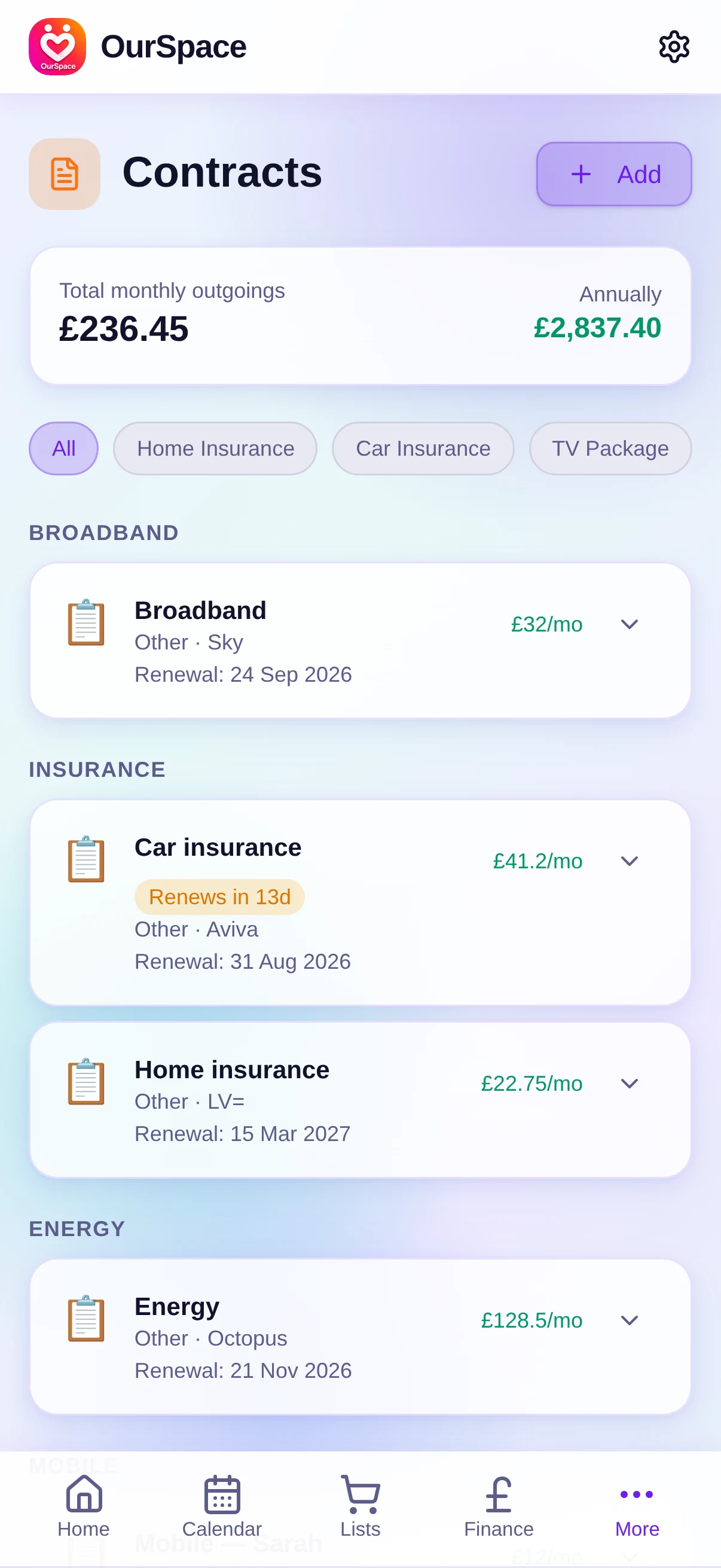
Every contract, its cost and its date, with one flagged amber
The rest of the app is the household around it: both partners' Google Calendars side by side, shared shopping lists and tasks, an AI meal planner, budgets, bin days and birthdays. There are no adverts and no subscription: £2.99 once on iPhone, free on Android and the web.
Setting it up is one cup of tea
- Gather the paperwork, or just open each provider's app or account page. The contract end date is on every Ofcom-required notification, every insurance schedule and most online accounts.
- Enter each contract with its renewal date, cost, account number and the supplier's phone number. Future you will ring up armed.
- Set the warning window per contract. I'd suggest more notice for insurance (time to run a comparison quote properly) and at least your notice period plus a week for broadband and mobile.
- If you can't find a date, that's a finding in itself: you may already be out of contract and overpaying today, which makes that supplier the first phone call.
Questions people actually ask
How far ahead should a renewal reminder fire?
My suggestion: three to four weeks for car and home insurance, so there's time to compare and still meet the renewal date; for broadband and mobile, your notice period plus a comfortable margin (the provider's end-of-contract notification states the notice period); for an energy fix, a few weeks, and check when your supplier lets you lock in the next deal. In OurSpace the window is set per contract, so the insurance can warn at 40 days whilst the gym warns at 14.
Don't providers have to remind me anyway?
Broadband, mobile, landline and pay-TV providers must send an end-of-contract notification 10 to 40 days out, and an annual reminder if you stay out of contract; that's been Ofcom's rule since February 2020. Insurers and energy suppliers write before renewal too. The catch is that one letter to one person is easily missed, and it arrives on their schedule rather than when the two of you are ready to deal with it.
What happened to GetReminded?
GetReminded, the free Australian renewal-tracking app, was withdrawn from the App Store and Google Play in February 2026. Its website promises a relaunch, but at the time of writing it hasn't returned.
Does OurSpace switch providers for me?
No, and I'd be wary of anything that says it does it all for you. OurSpace reminds both of you in time, holds the account details and current price, and gives you a comparison link to start from. The decision and the phone call stay yours, which is where the savings actually come from.
What does OurSpace cost?
£2.99 once on the App Store, and nothing at all on Android or the web. I'm a one-man software firm in Buckinghamshire and OurSpace began as an app for my own household, so there are no adverts, no subscription, and your data is never sold. It was free everywhere until September 2026, and I said here that I'd tell you plainly if that changed, so here it is.
Every renewal, seen coming, by both of you
Put the household's contracts in one shared place and let the reminders find whichever of you is free to make the call.
Try OurSpace